

SZEGED, Hungary (CN) - For Gerg Farkas - just as it is for so many younger Hungarians - the outcome of Sunday's parliamentary elections can be called existential.
And if Prime Minister Viktor Orban adds another four years to his 16-year reign, life in Hungary may become intolerable and even hopeless for people like Farkas - even time to leave.
On Sunday, Farkas will once again vote against Orban and his hard-right Christian nationalist Fidesz, a party that's dominated Hungary since 2010.
Over the past 16 years, the Fidesz machine remolded the constitution and gave itself unbridled power: it seized control of major media outlets and turned them into propaganda spigots; it made a handful of well-connected Hungarians into oligarchs; and it's greatly enriched Orban and his family.
"I do care about this place," Farkas said, pushing his toddler son in a stroller Thursday along a promenade on the levee of the Tisza River, a slow-moving waterway rich with historical meaning for Hungary.
"[The election] is really important for me and for my wife and I hope it will be important for him," the 36-year-old graphic design high school teacher said, nodding toward his son, whom he hopes will grow up in Hungary. "We just got tired of waiting for it to get better."
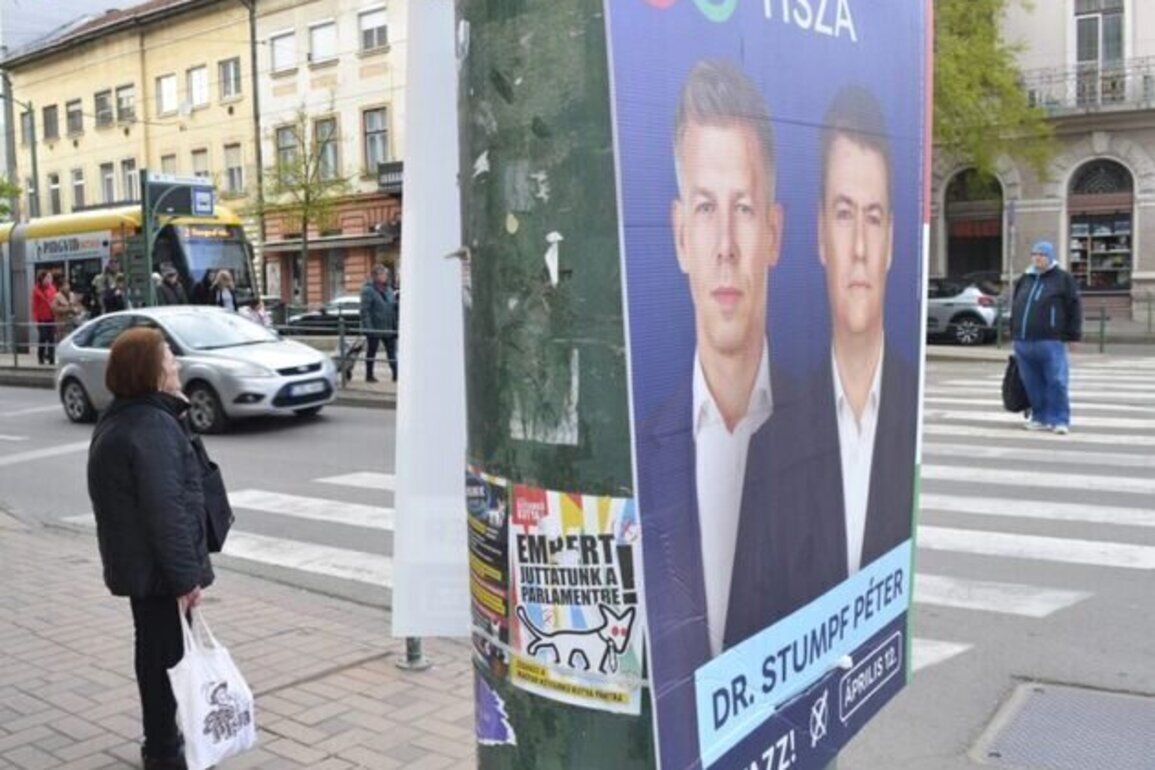
Today, the word Tisza carries historical meaning for a new reason: It's the name of an upstart political party led by Peter Magyar, a 45-year-old former Fidesz insider who's turned into a gifted and energetic politician channeling skills learned from his upbringing in a prominent family of Budapest lawyers. His great-uncle was a former Hungarian president, his mother a judge and his grandfather a celebrity Supreme Court judge who gave legal advice on television during the communist era.
In February 2024, Magyar left Fidesz and began mounting his challenge by denouncing Orban for corruption. At the time, his former wife, the country's former justice minister, had just resigned in a presidential pardon scandal linked to a pedophile case that had badly weakened Fidesz's moral standing.
Since then, Magyar's taken Hungary by storm with his charm and political savvy. He's even won over younger liberal and left-leaning voters, even though his politics could be described as Fidesz-lite.
His newly formed Tisza party took 30% of the vote in European Parliament elections in June 2024 and appears to be on the brink of unseating Orban and Fidesz in Sunday's national elections.
"We would like to hope," Farkas said about a Tisza victory. He's one those voting for Magyar not because he's so fond of his policies but because he sees him as the best option for ending Orban's rule.
"This is ground zero," he said. "Tactical election."
As he strolled away from the river and into the shadows of his city's grandiose university buildings, he lamented the state of Hungary under Orban.
It's so bad, he said, it can be compared to the inertia his parents experienced when Hungary languished under communism.
"What should the most important thing be for a leader? I think to make his or her people safe, happy, healthy and educated," he said. "But if you ask the doctors, the teachers and just the normal, ordinary people who are not related to the main party, they can tell you the truth."
The art school where he teaches, one of the country's oldest, uses computers that are 15 years old and tables and desks that are even older, he said. Many hospitals are understaffed and falling apart, he added.
"I don't like the fact that education means nothing, general health means not that much" to Fidesz, he said.
Instead of dealing with Hungary's real problems, he said Orban has succeeded time and again in distracting voters with fears and fake issues.
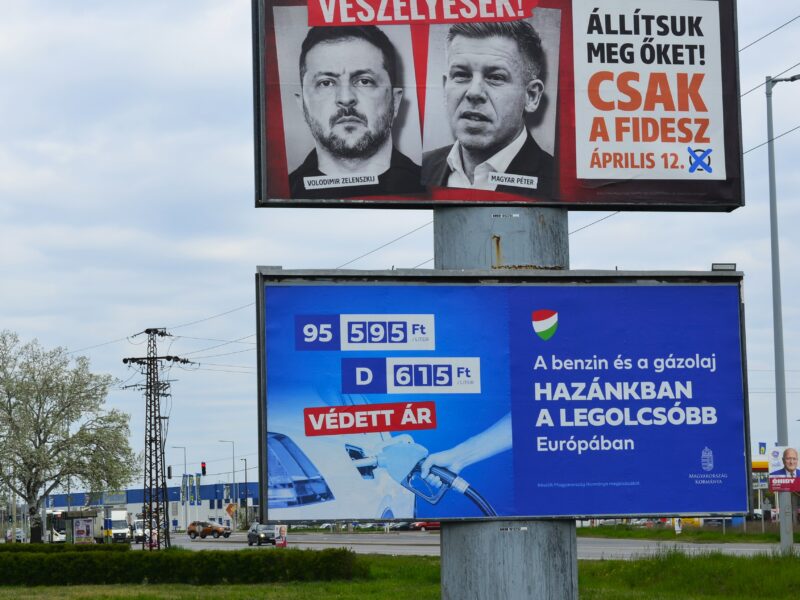
In this election, Orban has focused on telling Hungarians they'll get dragged into the Ukraine war unless they vote for him. Fidesz posters pop up all over Hungary depicting Ukrainian President Volodymyr Zelenskyy and Magyar as co-conspirators in this plot.
"You can see the billboards, which say, 'Fight against the war' and things like that," Farkas said. "What war? Just look around. I cannot see a war. I can see struggle."
For months, the most trusted polls have indicated Magyar is ahead of Orban by double digits and that Tisza may even obtain a supermajority in parliament, a result that would give it the votes to loosen Fidesz's grip on power by passing its own constitutional changes and purge Fidesz loyalists from key government positions.
But the election result may be far closer than independent polls suggest. In the last parliamentary elections in 2022, polls also suggested Orban might lose. He didn't.
Interviews with voters in Szeged, a city known for its left-leaning electorate, revealed surprising support for Fidesz. One such voter was Laszlo Kovacs, a 52-year-old owner of an antiquarium in Budapest.
For him, the attacks on Fidesz coming from opponents in Hungary and from foreign media and EU politicians painted a false picture of Hungary and of Orban.
"If you look around in the big cities, not just Budapest, in all the main cities, there is a lot of investment into the environment, into buildings, society," he said.
For him, the Orban years have been marked by the construction of about 500 miles of new highway and the development of regional airports. He also pointed to German carmakers and major battery manufacturers establishing factories in Hungary. BYD, the Chinese electric vehicle giant, has begun construction of a massive factory in Szeged.
Like other Fidesz supporters, he rejected the notion that Orban was on the far right and motivated by racial hatred. His supporters laud Orban for an ability to work with Romanians, Serbs, Slovenians and other nationalities in a part of Europe where animosities go back centuries.
At the same time, Kovacs fully supported Orban's move to close off Hungary's borders to asylum seekers since 2015 when the European Union was hit by a massive refugee influx caused by the Syrian civil war.
"Thank god," he said about Hungary's low number of immigrants. "I have two blonde-haired, blue-eyed girls and I wouldn't like immigrants here."
Kovacs said Orban's social programs, such as generous tax incentives for children and price caps on food and fuel, are the kind of policies left-wing parties would enact, not a far-right party.
As for bans on gay pride parades pushed by Fidesz, he said that was simply in keeping with the country's conservative nature.
"Anyone can be gay in Hungary, nobody will punish them for that," he said. "We just don't like it if they go on the streets and advertise themselves as though this is the only possible way."
Kovacs also shrugged off the damage caused by Orban's isolation in Brussels, where he has become a sort of cartoon villain for EU leaders due to his intransigence and vetoes, most notably on aid to Ukraine.
For years, the European Commission has waged legal and political battles with Orban and withheld billions of euros in EU funds from Hungary over corruption concerns.
"It's not a good decision from the European Union, but if they don't want to give us money, OK, no problem," Kovacs said.
His family were longtime Fidesz supporters and backed Orban's anti-communist stance in the 1980s when he rose to prominence as a student activist opposed to the communist regime.
While anti-Orban voters viewed a Fidesz win as deeply troubling, Fidesz voters also expressed deep suspicions about Magyar.
"He says one thing on Monday and he says the total opposite thing on Tuesday," Kovacs said. "There is no consistency."
More troubling, Kovacs said Magyar's inner circle was made up of people linked to multinational corporations.
"I don't think they will represent the Hungarian people," he said.
There is another aspect to Magyar that may hurt him at the polls: Doubts about his personality and private life.
Magyar obtained mid-level jobs in Fidesz while he was married to Judit Varga, the former justice minister.
But Varga publicly accused him of a yearslong pattern of domestic abuse, including physical violence, psychological terror and blackmail. Magyar dismissed the accusations as false.
"A lot of Tisza fans just close their eyes" when it comes to Magyar's potential misconduct, Kovacs said.
"Fidesz voters vote for Fidesz and Tisza voters vote against Fidesz," he said. "They are not voting for something, they are voting against something."
Even with polls suggesting Orban's era may be coming to an end, Kovacs said he still liked Fidesz's chances.
"I think nobody knows what will happen," he said. "This is the most unpredictable election."
He added: "They always say all the Fidesz voters just come out from under the bush on the day of the election."
Still, the momentum seems to be on Tisza's side with younger voters in the driver's seat.
In a main square in Szeged, enthusiasm for Tisza was on display as a group of volunteers handed out stickers and pamphlets to passersby.
For Orls Mate, a 20-year-old economics university student, a Tisza victory would represent a chance for Hungary to turn in a more promising direction. By contrast, a Fidesz win was a dire prospect that might force him to leave Hungary.
"I like this country, I don't want to leave that much, but if I have to go, I will go," he said. The election, then, was "kind of a life or death situation, sorry to say."
"I'm hoping that Tisza will bring some new life into this country and hopefully they will bring us new jobs and make this country a lot more livable and lovable," he said.
"Tisza will win this election, hopefully, and I hope that our generation will be remembered for bringing about a better future for our country," Mate added.
Gyrgy Kalmar, a 35-year-old computer science professor, said he felt Magyar was the right person to finally kick Orban out of office.
"This has become one of the most critical elections in Hungary's history, or in the last century, because we have to change direction," he said.

But he was anxious the vote would be closer than expected due to Fidesz's powerful propaganda machine and dirty tricks. Fidesz faces accusations of vote buying in rural areas.
"The propaganda is so strong and many elderly people don't have access to social media or ways to fact check things," he said. "They just believe what's in the news and the news is very biased."
With a grimace, he added: "There will be cheating."
He said it was known rural mayors force public workers to vote for Fidesz and make them prove it by taking photographs of their ballots when they are in the voting booth.
But this time around, he felt support for Tisza was so big around the country that even cheating could be kept in check.
"We don't really have plan B," he said, referring to his wife and small child. "We only have plan A that Tisza wins and the future gets better."
Courthouse News reporter Cain Burdeau is based in the European Union.
Source: Courthouse News Service