

The hros et hrones vlo (heroes and heroines on bicycles), having accomplished themonumental feat of cycling across Europe from Novi Sad to Strasbourg between 3 and 15 April 2025, have continued to reinvent new ways to powerfully advance the cause of Serbian students, who have been relentlessly mobilising for over six months, both in their country and beyond. Their venture in theTura do Strazburawas immediately followed by a second crossing of the continent this time on foot, heading towards Brussels.
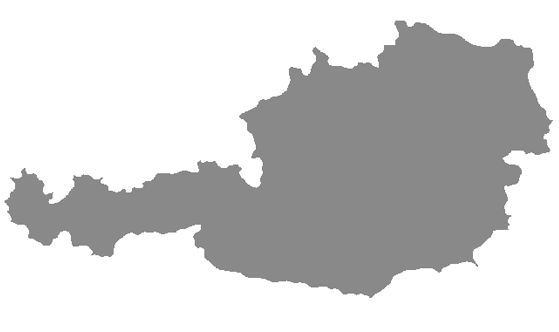
This mobilisation took the form of a 1,950-kilometre ultramarathon, completed in just 18 days by a determined group of Serbian students and activists as part of the extraordinary journey known asTrka do Brisela(Track to Brussels). Starting in Novi Sad, this relay run brought the participants to the European capital, covering over 2,000 kilometres across eight countries (Serbia, Croatia, Slovenia, Austria, Germany, France, Luxembourg, Belgium). A core group of 21 students, known asTrkai u Blokadi(Runners in Blockade), was joined by several student-led teams providing essential support, including physiotherapists, drivers, logistics and organisational coordinators, communications staff, and more.
The Serbian student movement, which has gathered momentum over the past six months, originated in the aftermath of the 1 November tragedy, when thecollapse of a recently renovated canopy at Novi Sads train stationclaimed the lives of 16 people. This tragedy sparked acollective response against the systemic corruption afflicting Serbia, and the protest itself became a wake-up call for the entire continent, where similar issues and ethical dilemmas continue to hinder the healthy development of societies on political, economic, educational, and cultural levels.
Serbias Road Heroes and Heroines: On Bicycles and on Foot, with Conscience and Determination
United under a common banner, the fight against corruption, the Serbian movement has been structured around the mechanism known asplenumsthat conceived as true pillars of a model of direct and participatory democracy currently being tested. Rejecting any drift towards personality cults, superficial activism, or ideological instrumentalisation, such movement has so far maintained a clear independence from debates surrounding the EU accession and pending chapters, as well as from national or regional controversies, focusing instead on the key points of systemic change and fight against corruption, which are presented as urgent and of utmost priority.
This rolling uprising, with its university occupations (widely known as blokade in the Serbian protest context) as symbols of resistance, fuses mobility and creativity to generate unprecedented popular participation. Its energy, its participatory processes, its continual innovation, and the unwavering resolve of its protagonists have turned it into a genuine mass movement. Young people are its driving force, inspiring other generations to get involved and striving to halt themigration exodus plaguing all of Southeast Europe, especially Serbia. Arecent study by the Friedrich Ebert Foundationreveals that Serbia faces the greatest mismatch between education and employment among 12 surveyed countries: in 2024, only 20.7% of young people work in their field of study, and 83.2% are overqualified for their jobs.
At the heart of this dynamic, from the cycling expedition to Strasbourg, to the marathon from Novi Sad, and above all, from the symbolic departure from the home villages of the 21 runners to Brussels, the Serbian diaspora has played a crucial role. It has supported the students demands, swiftly establishing a remarkable grassroots hosting network of families based in Brussels, as had already been done in other European cities. From Austria to France, Germany to Hungary, the Netherlands to Slovenia, these diasporic communities have acted as a genuine transnational and intergenerational engine, giving the protest a truly European scope. They show that the Europe of its peoples can come before, and even outlast, the political and institutional Europe when it fails to respond to the challenges of our time.
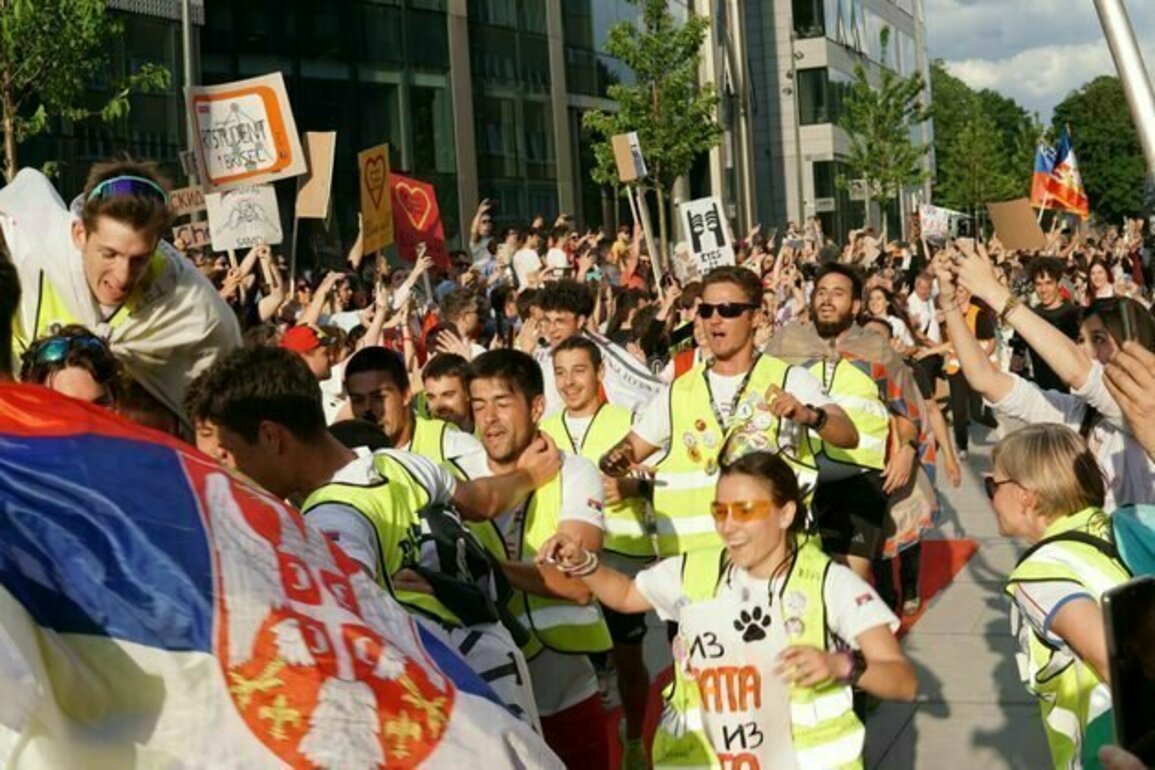
In Belgium, thestudent-marathoners arrived in Lige at sunset on Sunday 11 May, warmly welcomed there with songs, banners, messages of support, joyful embraces, and speeches byDragana Radanovifrom the diaspora collectivePalac Gore, andSarah Schlitz, a Member of Parliament from Lige for the Ecolo-Groen group in the Chamber of Representatives. The following day, after 18 days of running and crossing 7 countries, therunners finally entered Brussels. They reached Parc du Cinquantenaire just before 8 p.m., passing beneath the Triumphal Arch in the golden evening light, carried by a spirit of unity and a powerful sense of youth forging new paths beyond borders and divisions.
To the tune ofBella Ciao, the anthem of the Italian partisans and today sung worldwide as an anti-fascist hymn of freedom and resistance, and performed by street pianistDavide Martello, now a familiar and unwavering presence at contemporary sites of protest, where he uses his battered piano to send messages of peace and harmonic solidarity, the marathoners crossed beneath the arches of the Cinquantenaire park. As had already happened in other cities, even on the outer edges of the continent, Martello allowed a child to play for a moment, giving up his stool, just before the runners were swept up by the crowds excitement. From that moment on, the celebration erupted in a festive atmosphere to the rhythm of Pumpaj, featuring an unmistakable Pikachu hat that was renamed Trkachu (a kind of Pikachu running) by the youngest marathon runner of the group followed by emotional reunions and endless hugs with her loved ones who had arrived by surprise with flowers in hand, and finally, a return into the arms of their team.
At that point, the Schuman roundabout quickly filled, bursting with joy, as the entire support team joined the expectant crowd, who had been imagining this moment for weeks, in a crescendo of anticipation and excitement. Journalists, local hosts, drivers, artists, institutional figures, members of the diaspora, and families all gathered to witness the arrival. Some participants began scanning the crowd, curiously searching for their potential hosts, while a robust hosting network, sometimes involving complete strangers, was organised with remarkable efficiency and incredible speed. By the end of the evening, every student had found a host family in Brussels or the surrounding areas.
Among those who came to show their support were members of the wider regional diaspora, not only Serbian, but also citizens of Bosnia and Herzegovina, Croatia, Montenegro, and others who had been inspired by the protest and were eager to meet the students they had followed from afar in recent months.
Through their journey and extreme physical feat, the students carried, and continue to build, a message of unity and cohesion that defies belief, transcending not only ideas of borders, but also their very practice. A message of synergy and love, captured poignantly in thewords of Maja, the groups youngest member and the only secondary school pupil among university students, who cut the ribbon marking the final metre and exclaimed, visibly moved: Thank you, thank you so much. Thank you to my travelling companions Do you know how strong you are, how full of energy, and how much you mean to me, how much I love you?
The programme blended celebration with solemnity. The Blokada Choir performed emblematic songs of the movement. A sixteen-minute silence was observed under a sudden rainfall. Several political figures marked their solidarity by attending the students arrival and offering words of support, including those by the Vice-President of the European ParliamentMartin Hojsk, followed byVula Tsetsi(Co-Chair of the European Green Party) andKathleen Van Brempt(Vice-President of the S&D group).
In this context, the arrival in Brussels is not merely the culmination of an extraordinary physical endeavour: it marks the beginning of a new, unimaginable phase, one ofrenewed calls for democratic accountability and civic engagement. Through their perseverance, these young people have captured the attention of European institutions and public opinion alike. Their footsteps, now faded beneath the Triumphal Arch of the Cinquantenaire, leave behind a resounding message: Serbias future must be rooted in democracy, human rights, freedom of expression, and the sovereign voice of its people.
Anna Lodeserto